Before we get to the regularly-scheduled show notes, Tony and Avi have a big announcement: They wrote a book!
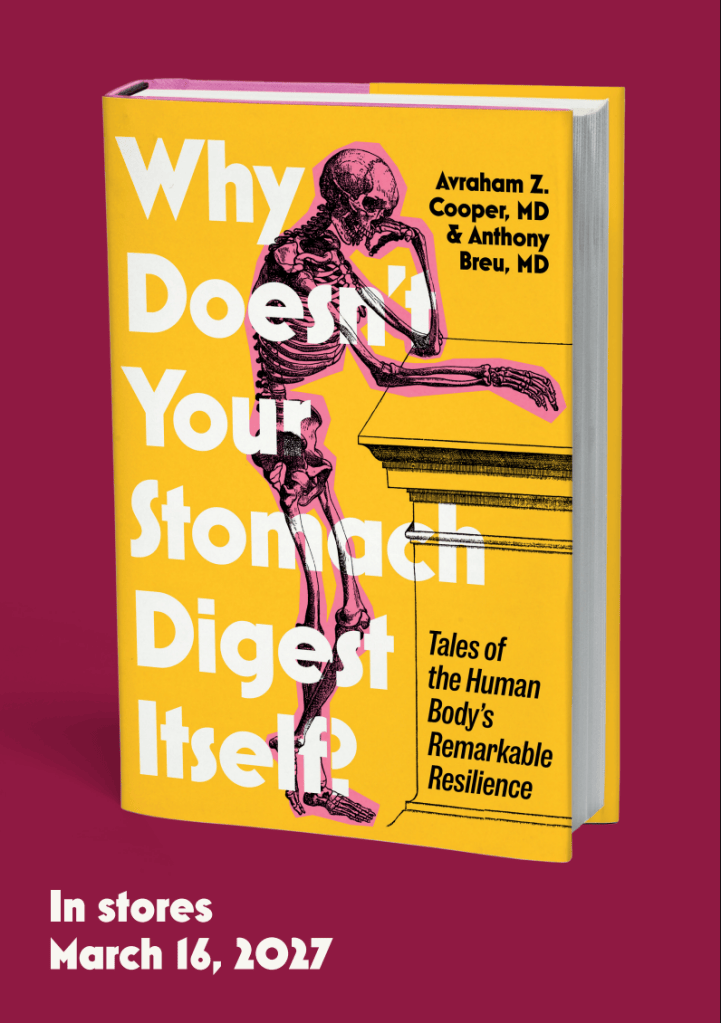
Why Doesn’t Your Stomach Digest Itself? Tales of the Human Body’s Remarkable Resilience is a celebration of the human body’s incredible ability to exist, heal, and endure. Each chapter explores a different resilience feature that keeps us ticking (think automatic sinus rhythm heart beats or nearly instant blood clotting or your stomach not digesting itself, of course), allows us to adapt to changing circumstances (e.g. neuroplasticity after hemispherectomy or the physiology of altitude acclimatization), and helps human bodies endure truly extreme circumstances (What mechanisms make it possible to run a 100-mile ultramarathon or survive as a castaway at sea for over a year or even falling out of an airplane?). Tony and Avi had such a blast writing it these last few years and Why Doesn’t Your Stomach Digest Itself? will be published by Norton on March 16, 2027. We really are so excited to share it with our listeners, and if you love this podcast then we think you’ll love this book.
You can pre-order your copy here, and share it with your friends and colleagues! https://wwnorton.com/books/9781324117117/about-the-book/description
Now, back to the show notes…
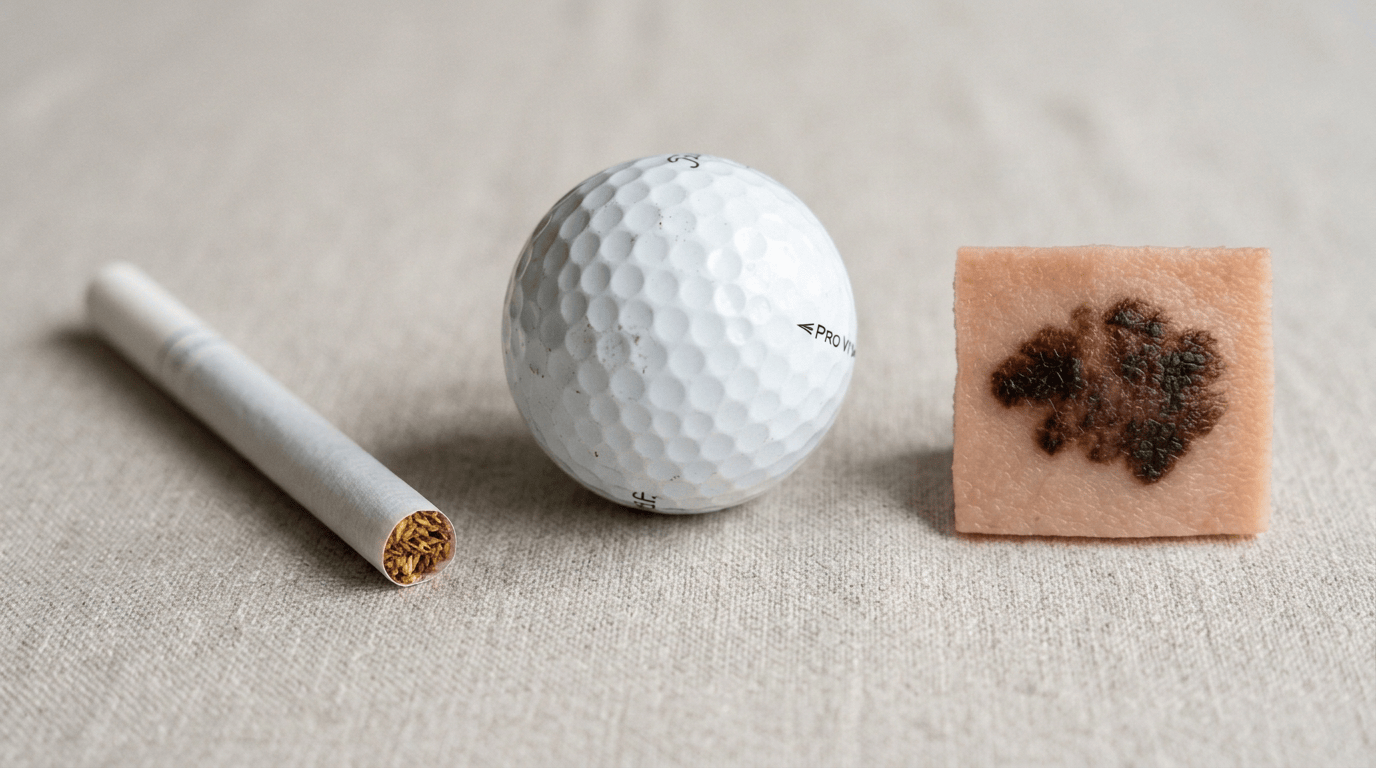
What connects golf courses, cigarettes, and melanoma?
Medicine loves triads. There’s Charcot’s (cholangitis), Whipple’s (insulinoma), Virchow’s (hypercoaguability), and many others (not to mention the tetrads and pentads). Here’s another triad: Golf courses, cigarettes and melanoma. What do they have in common with each other, other than maybe bachelor parties? Parkinson’s disease (PD). Yes, really.
Before we get your hopes up, this isn’t some well-established triad of risk factors for Parkinson’s that’ll be making its way onto Step exams anytime soon. In fact, only one of them is even a risk factor.
In 2012, neurologists Margaret Parrish and Robert Gardner published an observational study in the Annals of Neurology where they reported that 19 of 26 patients in their Parkinson’s cohort lived on or within 2 miles of a golf course. A small sample size, to be sure, and ripe for confounding (Parkinson’s is most common in older men, and we all know about older men and golf …). However, in May 2025, JAMA Network Open published a population-based study using data from the Rochester Epidemiology Project in which they compared a cohort of 419 PD patients and ~5000 controls based on their proximity to 139 golf courses within a 16,000 square mile region in Minnesota and Wisconsin. Amazingly, the Parrish and Gardner observation held up: Patients who lived within a mile of a gold course had an aOR of 2.3 for PD compared to those living more than 6 miles away.
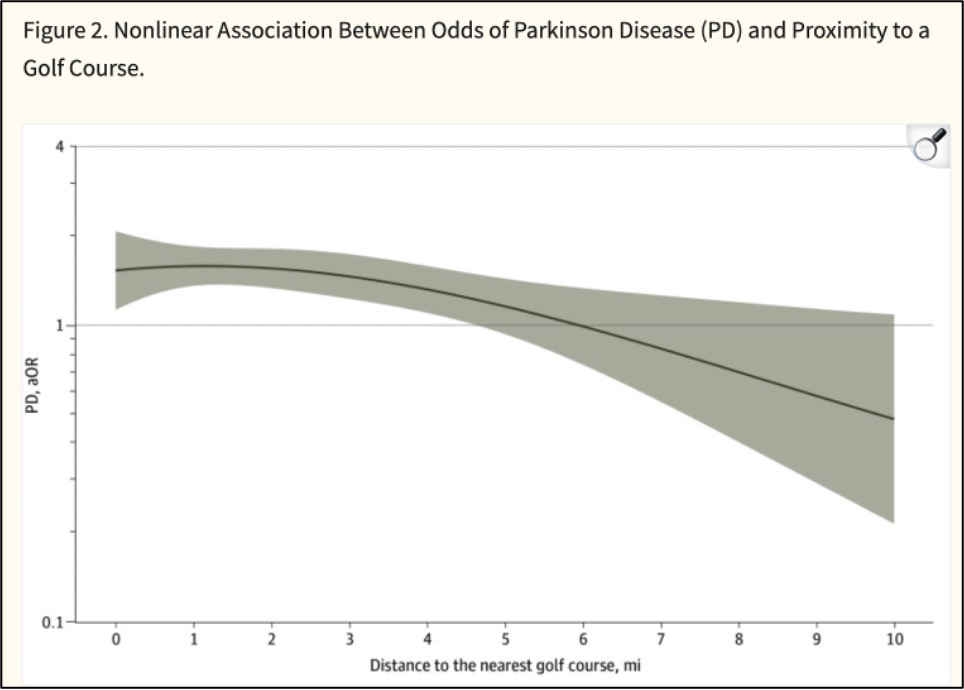
What’s driving the risk isn’t clear. Parrish and Gardner posited that it was something airborne, as 16 of the 19 PD patients lived downwind of the gold course. The JAMA study authors instead worried about groundwater contamination, as the grass of many golf courses is maintained with organophosphates and other agricultural toxins that could leach into the surrounding community. If chronically ingested, these compounds can lead to oxidative stress, mitochondrial dysfunction, and eventually dopaminergic neuron apoptosis.
If living near a golf course is the risk factor, that means that smoking, for once, isn’t. In fact, it may even be protective against PD, just as it’s been proven to protect against ulcerative colitis and preeclampsia. This was first noted in the 1960’s, where the thought was that the nicotine in tobacco might be metabolized to nicotinic acid and alter dopamine metabolism. In 2022, researchers formally investigated the connection and found that smoking not only was protective against PD, there was a dose-dependent relationship. At 5 cigarettes per day, the risk difference was 0.79, but as you increased from 10 to 20 to 40 cigarettes per day the risk dropped from 0.65 to 0.54 to 0.49. Is it the nicotine, though? A 2025 study of nearly a half-million adults in China also found a protective relationship between smoking and PD. However, even amongst adults who had never smoked, higher levels of exhaled carbon monoxide (a main component of cigarette smoke) were associated with decreased PD risk. This was also dose-dependent, which contextualizes why in other studies more cigarettes per day decreased risk of PD.
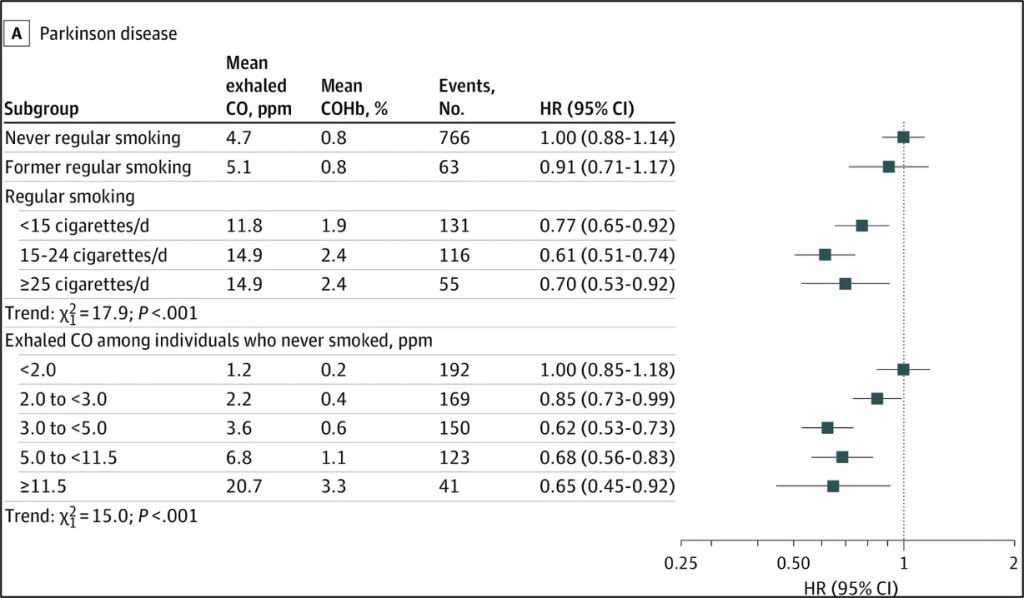
How exactly carbon monoxide would be protective against PD is unclear (there is some preclinical data showing that low-dose carbon monoxide reduces dopaminergic cell loss and α-synuclein pathology). That hasn’t stopped the creation of the “Low-dose Carbon Monoxide (HBI-002) Trial to Evaluate Safety, Tolerability, PK, and Biomarkers in Parkinson’s Disease”, aka the LoCaMoTE-PD study, which uses low-dose liquid carbon monoxide.
So golf courses increase risk of PD and cigarettes decrease risk. Where does melanoma fit into the triad? It’s been known since the 1970’s that PD patients have a 2 to 6-fold increased risk of melanoma. The initial worry had been that levodopa was the culprit, but subsequent studies have shown the risk is increased even before patients get on medication. Rather than cause or effect, melanoma and Parkinson’s seem to be fellow travelers. In PD, dysregulation of alpha-synuclein proteostasis leads to neurodegeneration. That same dysregulation, in theory, leads to melanin cell cycle dysregulation and eventually malignancy.
While you shouldn’t encourage patients to smoke, and probably shouldn’t make them flee their house because it’s near a golf course, at the very least it’s worth doing an extra-careful skin exam next time you see a patient with PD.
Take Home Points
- Living near a golf course is associated with Parkinson’s disease. Whether this is related to air, water, or some other exposure or confounder hasn’t been fully worked out.
- Cigarette smoking is associated with a lower risk of Parkinson’s disease. This might be related to carbon monoxide exposure. Trials are ongoing!
- Melanoma is associated with Parkinson’s disease and has historically been blamed on levodopa. It is more likely that these two conditions share a common cause.
Sponsor
This episode was sponsored by FIGS. FIGS is offering 15% off your first purchase. Just go to wearfigs.com and use the code FIGSRX at checkout
Listen to the episode!
https://directory.libsyn.com/episode/index/id/43571394
CME/MOC
Click here to obtain AMA PRA Category 1 Credits™ (0.5 hours), Non-Physician Attendance (0.5 hours), or ABIM MOC Part 2 (0.5 hours).
As of January 1, 2024, VCU Health Continuing Education will charge a CME credit claim fee of $10.00 for new episodes. This credit claim fee will help to cover the costs of operational services, electronic reporting (if applicable), and real-time customer service support. Episodes prior to January 1, 2024, will remain free. Due to system constraints, VCU Health Continuing Education cannot offer subscription services at this time but hopes to do so in the future.
Credits & Suggested Citation
◾️Episode written by Tony Breu
◾️Show notes written by Tony Breu and Giancarlo Buonomo
◾️Audio edited by Clair Morgan of nodderly.com
Breu AC, Abrams HR, Cooper AZ, Buonomo G, Manna, M. Parkinson’s Potpourri. The Curious Clinicians Podcast. October 21st, 2026.

