

Did President Franklin Delano Roosevelt truly have polio, or is an alternate diagnosis more likely?
Over time, some narratives in medical history become regarded as settled truth, despite being a great deal more nuanced. Saying that Edward Jenner “invented vaccines” or that penicillin was the “first antibiotic” isn’t false so much as it’s incomplete. On this episode, we’ll tackle one narrative that, while believed now by generations of Americans, may actually be false. If we asked you why Franklin Delano Roosevelt spent most of his adult life and his entire presidency in a wheelchair, you’d probably say polio, right?
In 2003, medical historians Daniel and Armond Goldman, Elisabeth and Frank Schmalstieg, and Daniel Freeman explore this question in an article entitled “What was the cause of Franklin Delano Roosevelt’s paralytic illness?” published in the Journal of Medical Biography. To understand where decades of contemporary and posthumous diagnosis may have gone wrong, we first have to go back to 1921. FDR is in the prime of his life. He had just spent 7 years as Assistant Secretary of the US Navy and had recently been the Democratic Party’s vice presidential nominee in the 1920 election, which he and James Cox lost to Warren G. Harding and Calvin Coolidge. He was on vacation with his family on Campobello Island in Canada when, on August 10th, he developed lower back pain and chills. He went to bed to sleep it off, only to awaken with a high fever and unilateral leg weakness with numbness and pain. Over the next few days, his fever persisted, the weakness and pain spread to his other leg, both arms and face, and he developed bowel and bladder dysfunction, all signs of a rapidly progressive neurologic illness.
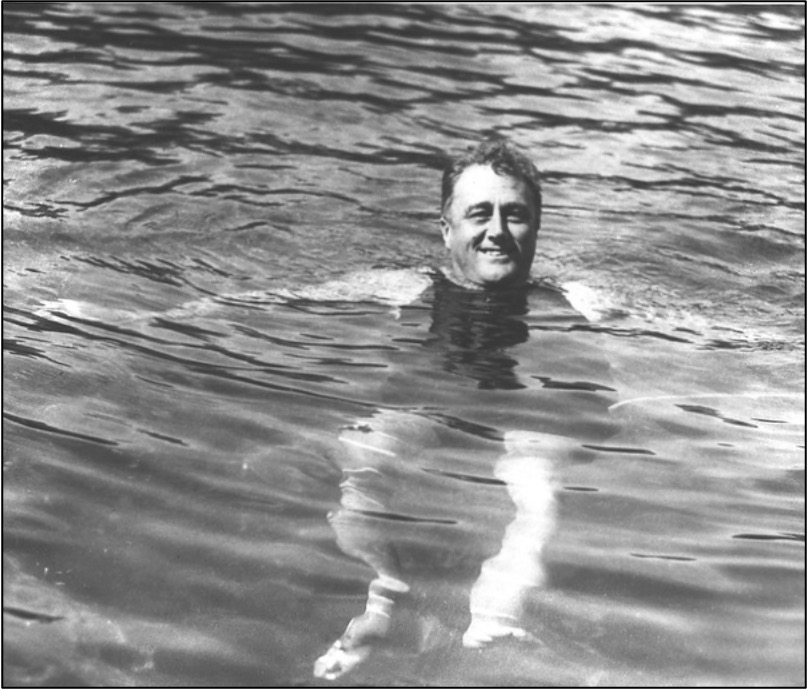
Several doctors tried to make a diagnosis. Before his neurological symptoms became profound, Dr. EE Bennet thought it was just a common cold. Then, a surgeon also on vacation named Dr. WW Keen proposed that FDR had ““a clot of blood from a sudden congestion – settled in the lower spinal cord.” Finally, Dr. Robert Lovett, an orthopedic surgeon and polio expert from Harvard Medical School, examined FDR and decided that he had polio.
To be clear, this was by no means a lazy or ignorant diagnosis. Before the arrival of vaccines in the 1950’s, polio was a common and much-feared plague of American life, infecting thousands of people a year and leaving many permanently disabled and even dependent on iron lungs to breath. There was no serologic test at the time to confirm the diagnosis and Roosevelt fit much of the illness script. He had a febrile illness with diffuse weakness, some of which slowly improved over the next few years, but by 1923 Lovett examined him and noted that “there was no motion in his hamstrings. His toes showed no more than a trace of motion.” He would remain paralyzed from the waist down for the rest of his life.
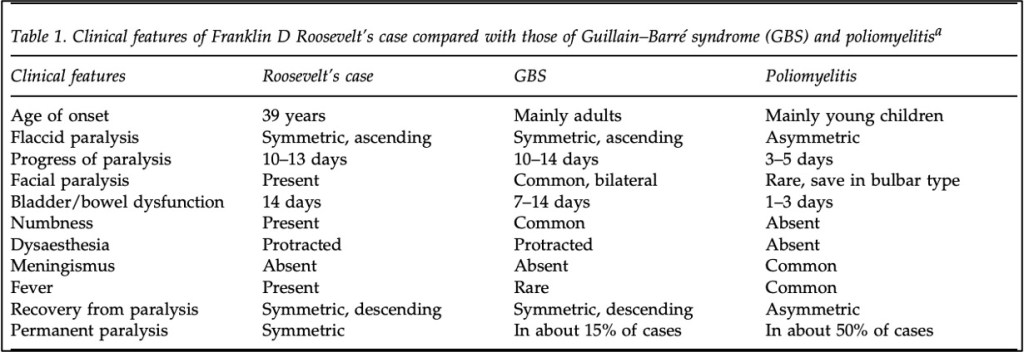
However, as the authors of the above-mentioned article point out, there are several elements of the story which don’t match polio. The first, and in some ways strongest, argument against polio is FDR’s age. Polio was so feared, in part, because the patients with the worst outcomes were children. In a 1916 polio outbreak in New York City, the incidence of paralytic polio was 3/100,000 for people aged 25 or older, whereas for 2 year olds it was 1945/100,000. Even when polio was commonplace, it would have been rare for a 39 year-old man to have such devastating complications.
If we closely re-examine FDR’s symptoms, some of them don’t match polio. We’re told that he had acute-onset paralysis, numbness and neuropathic pain in both of his lower extremities, which spread to his face. Classically, polio causes asymmetric weakness, doesn’t have bulbar symptoms, and because the virus infects motor neuron cell bodies in the spine, the acute phase has no sensory symptoms (those can be part of post-polio syndrome, but more chronically).
Now, one could argue that amongst the hundreds of thousands of polio victims in that era, FDR could have just been an atypical case. But is there a diagnosis that better fits his presentation? An adult male presents with fever and rapidly-progressive, symmetric, ascending paralysis with sensory symptoms that reaches the face, and then slowly recovers in a descending pattern. That is a textbook case of acute inflammatory demyelinating polyneuropathy, better known as Guillain-Barré Syndrome (GBS), which is an autoimmune demyelinating process of the peripheral nerves, usually incited by an infection, particularly campylobacter . Although GBS is often self-resolving, a minority of patients are left with chronic inflammatory demyelinating polyneuropathy (CIDP), which could explain FDR’s permanent lower-extremity paralysis.
You might be wondering why we sounded so forgiving a few paragraphs ago about the presumptive diagnosis of polio. If this was textbook GBS, why didn’t all of these experts anyone pick up on it? The simple explanation is that in 1921, GBS wasn’t well known. The classic presentation was only first described in 1916 by three French neurologists, Dr. Guillain, Dr. Barré, and Dr. Strohl, when they reported cases of ascending paralysis in several French soldiers during the infamous Battle of the Somme. It wasn’t until 1927 that the term “Guillain-Barré Syndrome” was even coined. Why Strohl was omitted from the eponym is a matter for another time …
Other than for our own intellectual enjoyment, does any of this actually matter? Polio and GBS were both incurable at the time, and even if doctors had gotten the diagnosis “right” that wouldn’t have changed FDRs course. In a sense, it’s actually a good thing they got it wrong. FDR, who spent years rehabilitating himself and was still confined to a wheelchair, became an inspiration to thousands of polio victims. He established the Warm Springs Rehabilitation Center in Georgia, which developed into what was then called the National Foundation for Infantile Paralysis, better known now as the March of Dimes. Millions of Americans purchased lapel pins for 10 cents (ever wonder why FDR is on the dime?), and that money eventually funded Jonas Saulk’s development of a polio vaccine in 1955. Today, polio has been nearly eradicated, with only a handful of cases a year in severely resource-limited areas. FDRs may have had rarest diagnosis of all them all: The wrong one that was the right one.
Take Home Points
- Based on a modern re-examination of the case history, it seems possible, plausible, and perhaps even likely that President Franklin Delano Roosevelt may not have had polio, but rather Guillain-Barré that became chronic inflammatory demyelinating polyneuropathy or CIDP
- Be open to re-examining diagnostic assumptions when new evidence arises, which is an important skill for clinicians in general
Sponsor
This episode was sponsored by FIGS. FIGS is offering 15% off your first purchase. Just go to wearfigs.com and use the code FIGSRX at checkout
Listen to the episode!
https://directory.libsyn.com/episode/index/id/42957328
CME/MOC
Click here to obtain AMA PRA Category 1 Credits™ (0.5 hours), Non-Physician Attendance (0.5 hours), or ABIM MOC Part 2 (0.5 hours).
As of January 1, 2024, VCU Health Continuing Education will charge a CME credit claim fee of $10.00 for new episodes. This credit claim fee will help to cover the costs of operational services, electronic reporting (if applicable), and real-time customer service support. Episodes prior to January 1, 2024, will remain free. Due to system constraints, VCU Health Continuing Education cannot offer subscription services at this time but hopes to do so in the future.
Credits & Suggested Citation
◾️Episode written by Avi Cooper
◾️Show notes written by Avi Cooper and Giancarlo Buonomo
◾️Audio edited by Clair Morgan of nodderly.com
Cooper AZ, Abrams HR, Breu AC, Buonomo G, Manna, M. A President’s Polio. The Curious Clinicians Podcast. September 16th, 2026.
Image Credit : Wikimedia

