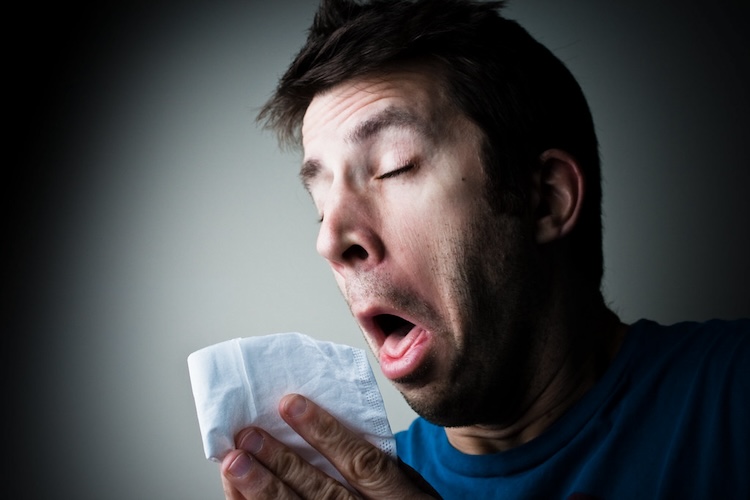
Why can sunlight exposure induce sneezing?
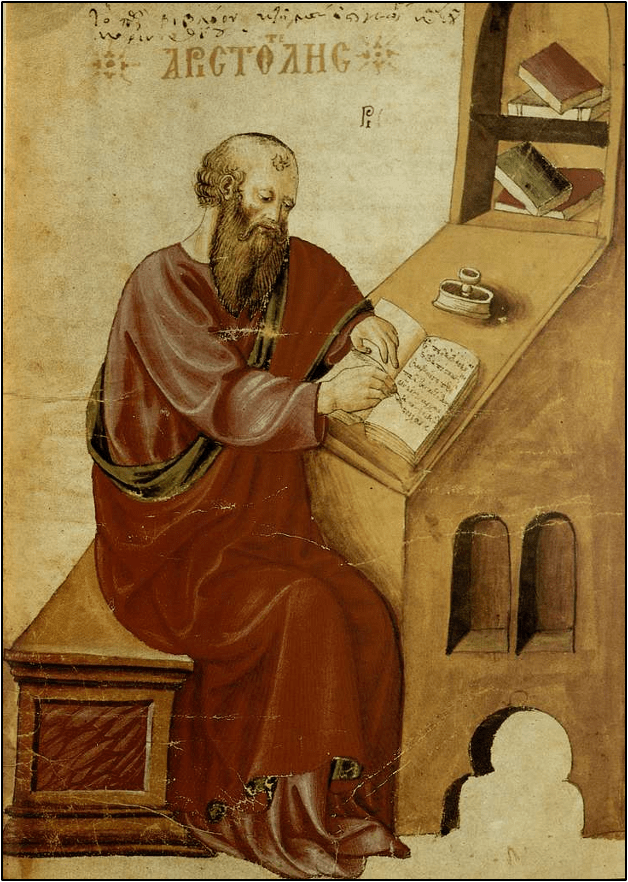
Achoo! Ever thought about why you sneezed when you stepped into sunlight? Well, this same question plagued even Aristotle himself, so much so that in The Book of Problems, he asked, “Why is it that one sneezes more after one has looked at the Sun?” His answer was that sneezing resulted from a chain of physical events in which the sun heated the nose, eventually triggering a person to sneeze. But, as you can probably guess, the story is a bit more complicated than that.
Aside from Aristotle being a very curious person (among many other examples, the Book of Problems is essentially an ancient FAQ about everyday life), this question probably arose, to some extent, from the metaphysical view the Greeks held of sneezing. For example, in The Odyssey, while Penelope is harassed by the suitors and Odysseus is still away, their son Telemachus lets out a loud sneeze. Penelope then interprets this sneeze as a positive and divine omen, in which the suitors were doomed to die. In Historia animalium, Aristotle frames sneezing as a sacred act, one that was tied even to prophecy. Additionally, in ancient Greek philosophy, a potential location of the soul was the head, with the nose serving as a portal of entry. We see echoes of this in how we respond when someone sneezes. We say “bless you,” “God bless you,” or “Gesundheit,” which means “good health,” after someone sneezes.
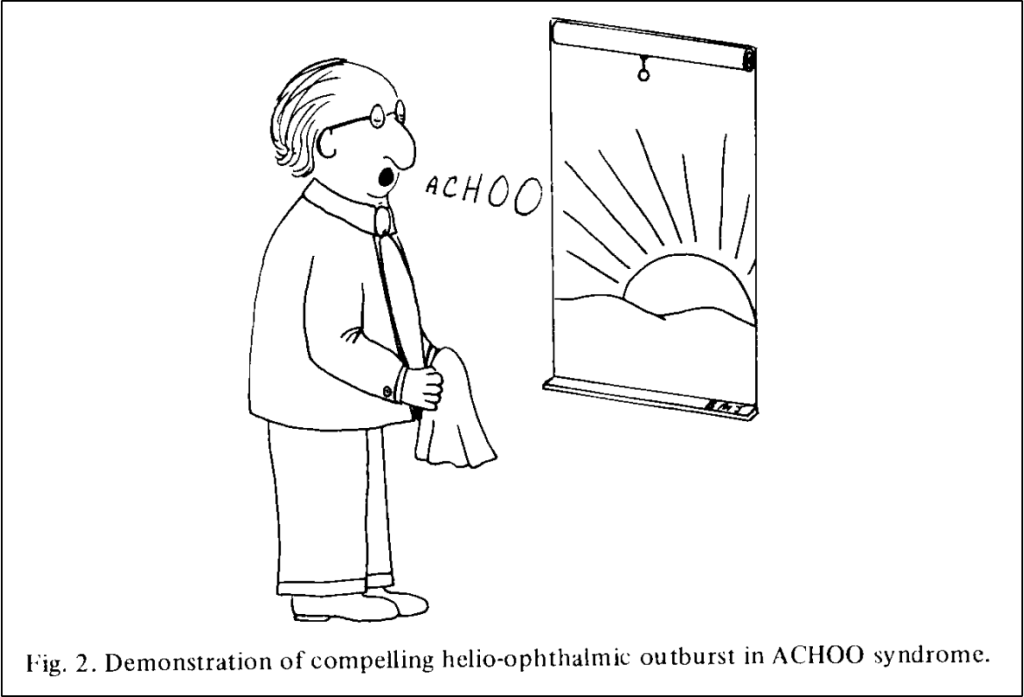
Funny enough, this phenomenon of sneezing in response to sunlight is aptly named ACHOO syndrome. It dates back to 1978, when four physicians–Collie, Pagon, Hall, and Shokeir–wrote an outstanding paper called ACHOO syndrome: Autosomal dominant Compelling Helio-Ophthalmologic Outburst. They proposed using this acronym to name photic sneezing – a suitably fitting name for a surprisingly common phenomenon. One 2017 study from Germany, published in the European Archives of Otorhinolaryngology, surveyed 1,000 patients in the ENT department at Saarland University Hospital. In this group of patients, 57% reported sneezing in response to sunlight exposure. Other studies have found a prevalence in the 25%-40% range. Interestingly, Japanese cohorts may be one exception, with prevalence lower in that population. Photic sneezing tends to be heritable, with an inheritance pattern consistent with autosomal dominance and variable penetrance.
About 1,800 years after Aristotle, Francis Bacon made an observation that was a helpful step in the right direction. Born in London in 1561, Bacon held the title of The Right Honourable First Viscount St Alban in the court of King James I. He was an early proponent of what we now consider to be the scientific method, and in that vein he brought an empirical approach to sunlight sneezing. He basically conducted a self-experiment by observing what would happen when he opened versus closed his eyes in bright sunlight. He found that he would sneeze when his eyes were open, but wouldn’t when they were closed. Instantly, he disproved Aristotle’s “nasal heat theory” and suggested that the eyes are involved.
Sneezing itself is actually a reflex involving the forceful exhalation of air, and its technical term is “sternutation,” which is derived from Latin. Sneezing occurs in two phases: the first phase is a spasm that leads to a sharp inhalation of air, the “AH” in ACHOO. The second is an oral-nasal expiratory phase, which is the “CHOO” portion.
So, where does this sneeze reflex come from? It’s less clear where sneezes come from in humans, but the best data for the existence of a brainstem sneeze center is actually in cats, who have been found to have one in their medulla. However, there is a case report that suggests that humans might have a sneeze center of some kind in the medulla. The paper 2005 and it involved a 66-year-old man who had what the authors called a “strategic infarct” in the right lateral medulla, close to the trigeminal tract. He had the expected symptoms, like ataxia and right-sided neurologic deficits, but he also had something else that was odd. His medical team could induce sneezing by stimulating his left nostril, but they couldn’t elicit any sneezing when stimulating his right nostril. They theorized that his stroke had knocked out a putative sneeze center in that spot.
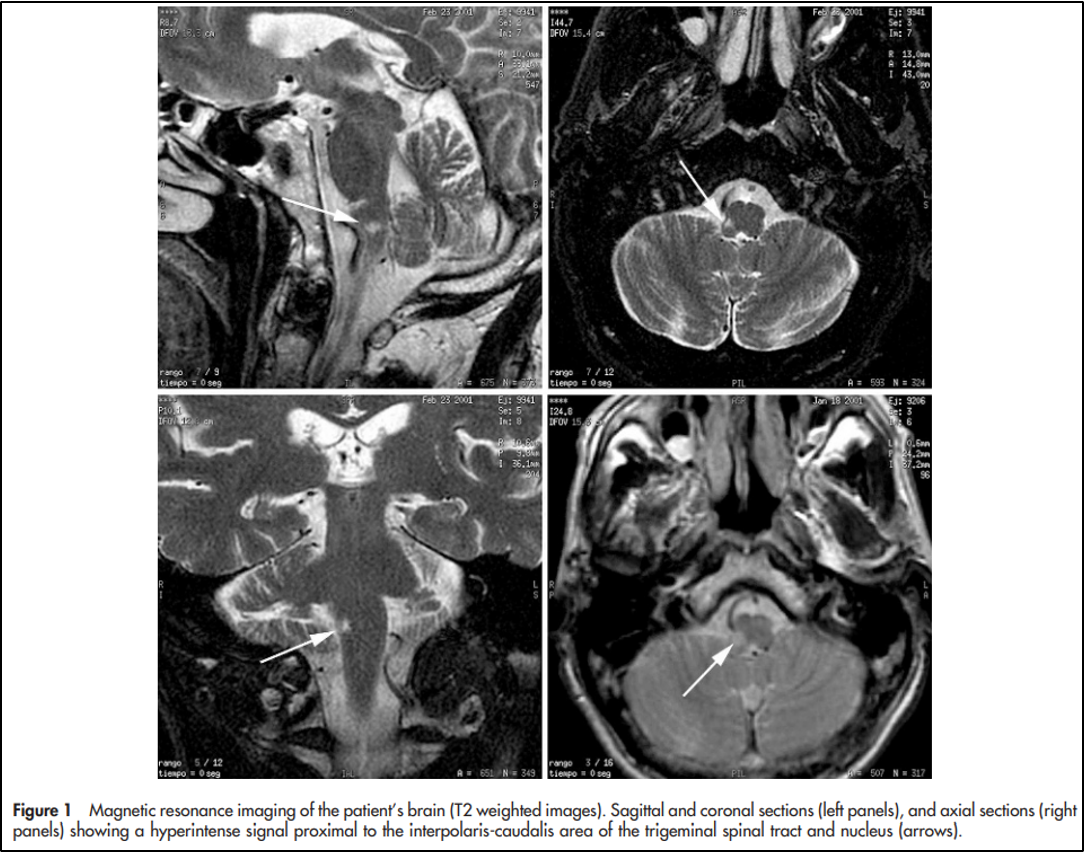
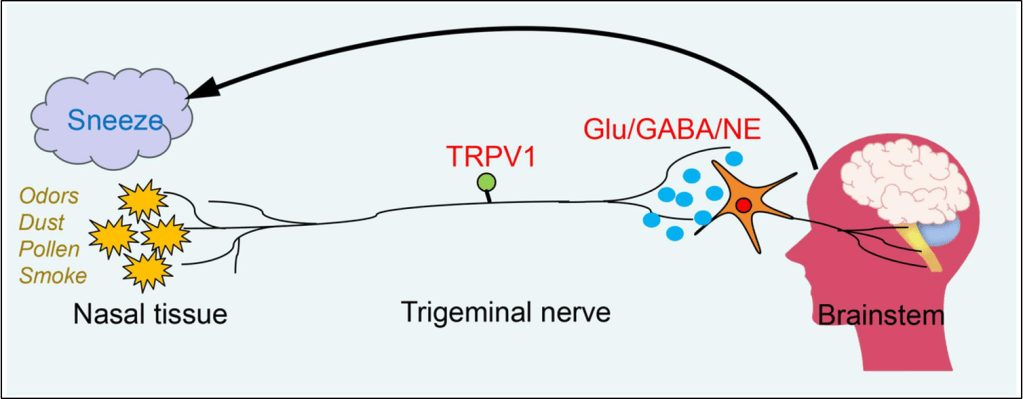
From the case report, the man’s stroke was right adjacent to the trigeminal tract (CN V), which is integral in the sneezing response. The sensation of something irritating your nose or face is actually routed to your brain through the trigeminal nerve. And that seems to be the key to this reflex, via an entity theorized to be optic-trigeminal summation. It is theorized to involve activation of the trigeminal nerve when the optic nerve (cranial nerve II) is stimulated by light. Because there are connections between the optic and trigeminal nerves in the brainstem, bright sunlight ends up stimulating the trigeminal nerve. This means light, rather than common triggers like dust, pollen, or odors, can cause a person to sneeze. There is also speculation that parasympathetic signaling might be playing a role as well.
But photic sneezing is more than just some odd physiological quirk. An interesting case report in 2023 described a patient whose sneezing interfered with a slit-lamp eye examination. This phenomenon also affects pilots who are routinely exposed to sunlight while flying. There was a paper written in 1993 that explored this concern under a fascinating title, “The Photic Sneezing Reflex as a Risk Factor to Combat Pilots”.
Take home points:
- Photic sneezing aka sneezing as a result of sunlight exposure is home to an epically good acronym – Autosomal dominant Compelling Helio-Ophthalmologic Outburst, or ACHOO
- The mechanism about this has been wondered about for thousands of years, from Aristotle to Francis Bacon
- It actually is theorized to relate to something called optic-trigeminal summation, where light stimulates the trigeminal nerve like dust or pollen would, leading to a sneeze
Tweetorial:
Listen to the episode!
https://directory.libsyn.com/episode/index/id/41707080
CME/MOC
Click here to obtain AMA PRA Category 1 Credits™ (0.5 hours), Non-Physician Attendance (0.5 hours), or ABIM MOC Part 2 (0.5 hours).
As of January 1, 2024, VCU Health Continuing Education will charge a CME credit claim fee of $10.00 for new episodes. This credit claim fee will help to cover the costs of operational services, electronic reporting (if applicable), and real-time customer service support. Episodes prior to January 1, 2024, will remain free. Due to system constraints, VCU Health Continuing Education cannot offer subscription services at this time but hopes to do so in the future.
Credits & Suggested Citation
◾️Episode written by Avi Cooper
◾️Show notes written by Avi Cooper and Millennium Manna
◾️Audio edited by Clair Morgan of nodderly.com
Breu AC, Abrams HR, Buonomo G, Cooper AZ, Manna M. The Sunlit Sneeze. The Curious Clinicians Podcast. June 19th, 2026.
Image Credit: Cold? – Flickr

