

Why is Duffy Null status associated with lower neutrophil counts?
What if we told you not everyone with a low neutrophil count is at a higher risk of infection? One cause of this fascinating phenomenon is known as the Duffy Null Associated Neutrophil Count, sometimes referred to as Duffy Null or DANC. It’s found in some individuals of African ancestry. It was previously named “Benign Ethnic Neutropenia,” but has largely been replaced by “Duffy-null associated neutrophil count” due to our understanding of the genetic basis of this condition and the medical community’s overall effort to move away from race-based medical terminology. Dr. Lauren Merz and others who have conducted extensive research on this condition have advocated for change and have largely achieved success.
Before we dive deeper, let’s begin by reviewing what we mean by Duffy Null. In episode 101, we reviewed red blood cell (RBC) antigens, and Duffy, one of the hundreds of antigens on red blood cells, was briefly mentioned. This antigen was first described in Nature in 1950, and its namesake was not the discoverers, but rather the patient from whom it was isolated. The Duffy antigen is also known as Duffy receptor for chemokines (DARC), and is a glycoprotein expressed on the surface of RBCs, endothelial cells, and other tissues. DARC is encoded by the gene ACKR1 and binds various pro-inflammatory chemokines, but acts as a decoy since it is non-signaling. Many individuals of West African ancestry carry a mutation in ACKR1, which results in the elimination of Duffy antigen expression on RBCs; thus, they are referred to as Duffy Null.
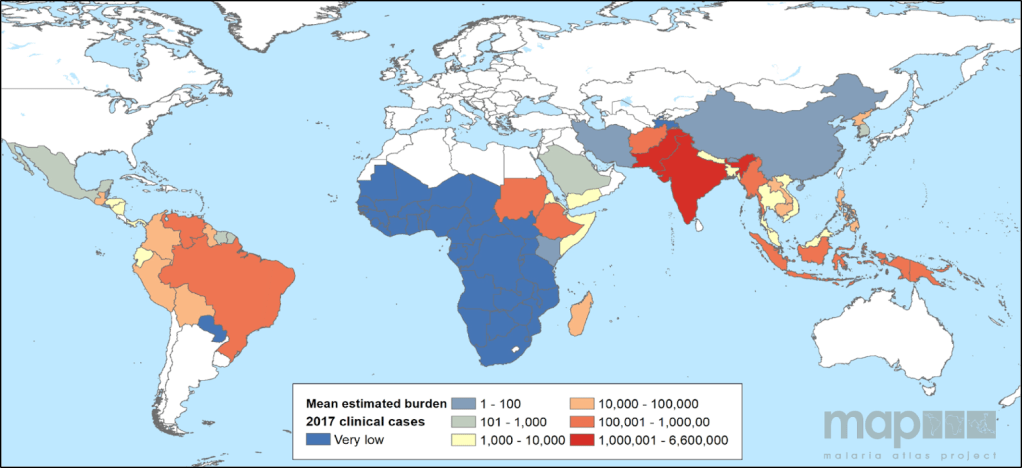
It comes as no surprise that the ACKR1 mutation confers an evolutionary advantage. The parasites Plasmodium vivax and Plasmodium knowlesi enter RBCs through the Duffy antigen. Thus, Duffy null individuals are almost entirely resistant to P. Vivax, which, according to WHO, is the leading cause of malaria infections in the majority of countries outside of sub-Saharan Africa. One paper discussed the potential future development of creating a DARC inhibitor against P. Vivax-induced malaria, drawing parallels to the creation of CCR5 inhibitors to treat AIDS from the uncovering that the CCR5Δ32 mutation had a protective factor from infection by HIV.
The Global Burden of Plasmodium Vivax Malaria
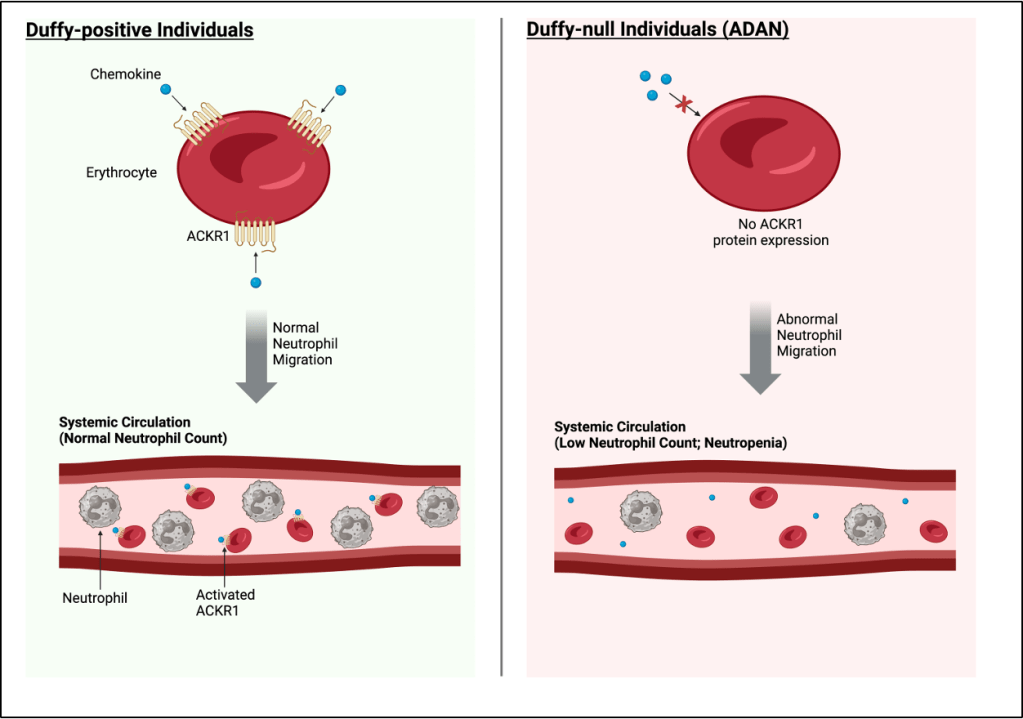
Let’s get back to our main discussion – what does the absence of an RBC antigen have to do with neutrophil counts? In a 2023 study by Dr. Merz and others, a reference range was established: the median absolute neutrophil count in DANC patients was 2,820/μL, significantly lower than the current institutional reference median of 4,750/μL. This is because the Duffy antigen binds chemokines. However, it acts as a chemokine sink, meaning it binds and removes chemokines from the circulation or tissue to modulate the bioavailability of these signaling molecules. It doesn’t initiate signaling, but more so acts as a buffer to ensure adequate local concentrations. Loss of DARC in RBCs impairs the handling of chemokines, which consequently affects the margination and trafficking of neutrophils, leading to the lower circulating neutrophil count observed in Duffy null individuals.
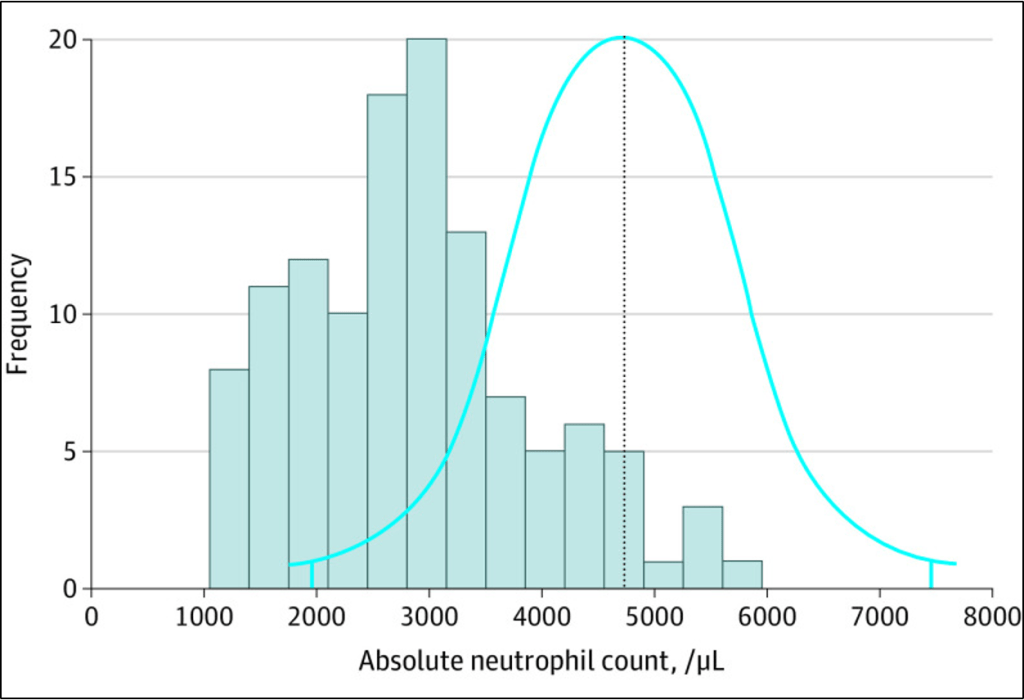
You may have noticed we have been referring to it as Duffy Null Associated Neutrophil Count instead of Duffy Null Associated Neutropenia, even though their neutrophil count isn’t too far off from the typical cutoff for neutropenia (<1,500/μL). This is because these individuals actually have normal total body stores of neutrophils, just not as many circulating in the bloodstream to be counted on a complete blood count (CBC). In some ways, this resembles the response typically seen after steroid administration, where there is an increase in the number of circulating white blood cells (WBC) in the bloodstream due to the demargination of neutrophils, thus raising the WBC count on a CBC, despite the total body neutrophil count remaining unchanged. The opposite happens in DANC. Although the mechanism isn’t entirely clear, a 1979 study using bone marrow aspirates from four DANC patients demonstrated normal cellularity and myeloid maturation, indicating that reduced circulating neutrophils are likely due to altered neutrophil release rather than decreased granulocyte production.
Despite the decreased count of neutrophils, Duffy null individuals are not at a greater risk of developing infections compared to those with the Duffy antigen. This is due to at least two reasons: first, the total neutrophil count in these individuals is normal, despite the low neutrophil count in the bloodstream. The second reason is that these individuals have normal neutrophil function, allowing them to effectively combat infections despite having a seemingly low neutrophil count.
Take Home Points:
- Duffy-null associated neutrophil count refers to the lower, on average, levels of neutrophils seen in those lacking the Duffy antigen on red blood cells.
- The Duffy antigen is a chemokine receptor that acts as a chemokine sink. In doing so, it alters the movement of neutrophils around the body. For those lacking Duffy on their RBCs, the loss of this function leads to a lower circulating neutrophil count.
- Duff-null status does not confer an increased risk of infection.
CME/MOC
Click here to obtain AMA PRA Category 1 Credits™ (0.5 hours), Non-Physician Attendance (0.5 hours), or ABIM MOC Part 2 (0.5 hours).
As of January 1, 2024, VCU Health Continuing Education will charge a CME credit claim fee of $10.00 for new episodes. This credit claim fee will help to cover the costs of operational services, electronic reporting (if applicable), and real-time customer service support. Episodes prior to January 1, 2024, will remain free. Due to system constraints, VCU Health Continuing Education cannot offer subscription services at this time but hopes to do so in the future.
Credits & Suggested Citation
◾️Episode written by Tony Breu
◾️Show notes written by Millennium Manna and Tony Breu
◾️Audio edited by Clair Morgan of nodderly.com
Breu AC, Abrams HR, Buonomo G, Cooper AZ, Manna M. Null Neutrophils. The Curious Clinicians Podcast. July 7th, 2025.
Image Credit: Health Tree Foundation
 The Curious Clinicians