
How could alpha-gal be used to treat cancer?
In episode 61 of The Curious Clinicians, we explored a rather odd complication of tick bites: “Alpha-Gal Syndrome ,” or an allergy to red meat. The culprit was galactose-α-1,3-galactose (alpha-gal), a carbohydrate which many mammals (and ticks) make but humans do not. The alpha-gal in tick saliva enters through the bite, which some people form antibodies to. When they eat red meat (which itself contains lots of alpha-gal), it triggers an allergic reaction. We also learned alpha-gal is the main molecule that causes the human body to reject xenotransplants like pig kidneys, and is even the reason why some people are allergic to the anti-cancer drug cetuximab (it contains alpha-gal).
Suffice to say, we cast alpha-gal as a villain. However, in this episode we’re discussing how alpha-gal may prove to be a hero. A paper several years ago posed an interesting hypothesis: What if Alpha-Gal Syndrome could actually be an anti-cancer mechanism? The foundational idea comes from some observational studies that suggest an inverse relationship between allergies and cancer, implying that IgE is able to kill cancer cells in addition to parasites. The proposed mechanism involves another carbohydrate we acquire from meat, N-Glycolylneuraminic acid (Neu5Gc), which is also expressed on the surface of cancer cells. The idea (which is just an idea), is that since many cancer-causing pathogens also produce alpha-gal, a tumor will start dividing more after a tick bite since it sees the tick alpha-gal as a sign that a competitor is in its vicinity. As the tumor divides, more Neu5Gc is displayed, which the immune system can then attack.
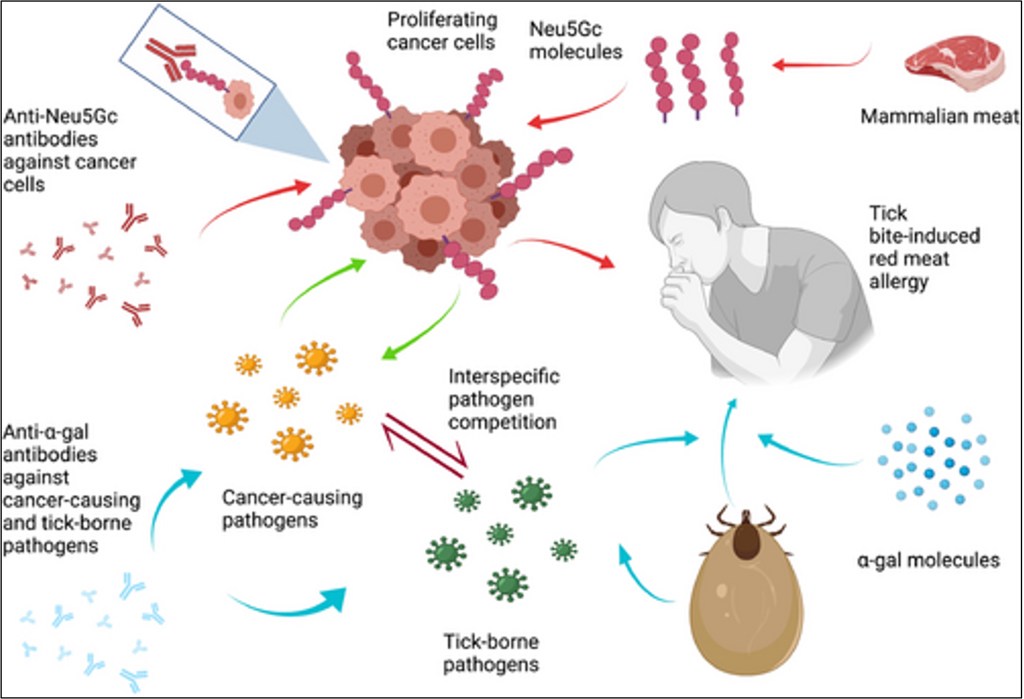
Again, this is just a theory. But if tumors express Neu5Gc and alpha-gal, could we harness the allergic reaction against those epitopes as a cancer therapy? Since cetuximab contains alpha-gal, you might wonder if patients who have hypersensitivity reactions have better cancer prognoses, since revving up the immune system against alpha-gal could help identify and kill cancer. That connection doesn’t seem to hold. There is a study which shows a positive correlation between the presence of a characteristic maculo-papular rash and cetuximab response, but that seems to relate to the drug’s EGFR inhibition causing inflammatory skin changes rather than anything to do with alpha-gal.
Things really get interesting when you look at a paper from 2024 in Cell. The researchers started out with two observations. First, that tumor cells often manipulate their surface receptors to make themselves effectively invisible to the immune system. Second, just as we discussed in our other episode, that alpha-gal is the primary molecule the body reacts negatively to in a xenotransplant, but via IgG antibodies, which require no pre-exposure, rather than the IgE ones typical for allergies that require an exposure. Put these two observations together and you have a potentially brilliant plan: Make tumors look like xenotransplants using alpha-gal, and the immune system will reject them.
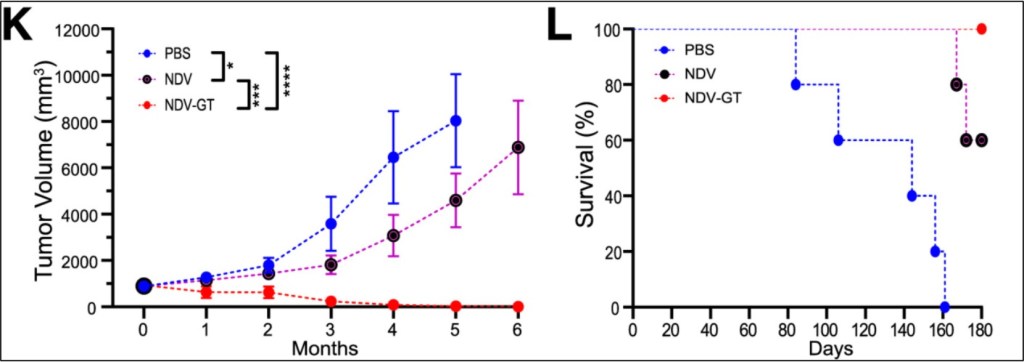
The question, of course, is how to get the alpha-gal inside the tumor. For this, the researchers utilized oncolytic viruses, or viral vectors that will be preferentially taken up by tumor cells. They took Newcastle disease virus, spliced in pig alpha-gal genes into its genome, and then exposed two groups of cells to it: One normal, and one isolated from various cancers like liver, breast and melanoma. They saw much greater uptake in the oncogenic cells. The researchers then infused this alpha-gal oncolytic virus and infused it into cynomolgus monkeys who had hepatocellular carcinomas. They found not only that the virus was significantly present in the tumors after 72 hours, but again, the tumors were the only tissue expressing alpha-gal. After 3 months they compared the tumor size in monkeys who got the alpha-gal virus compared to control monkeys with tumors who didn’t receive the virus. The experimental group saw 100% tumor regression. After 6 months, all the alpha-gal monkeys were still alive, and none of the control ones were.
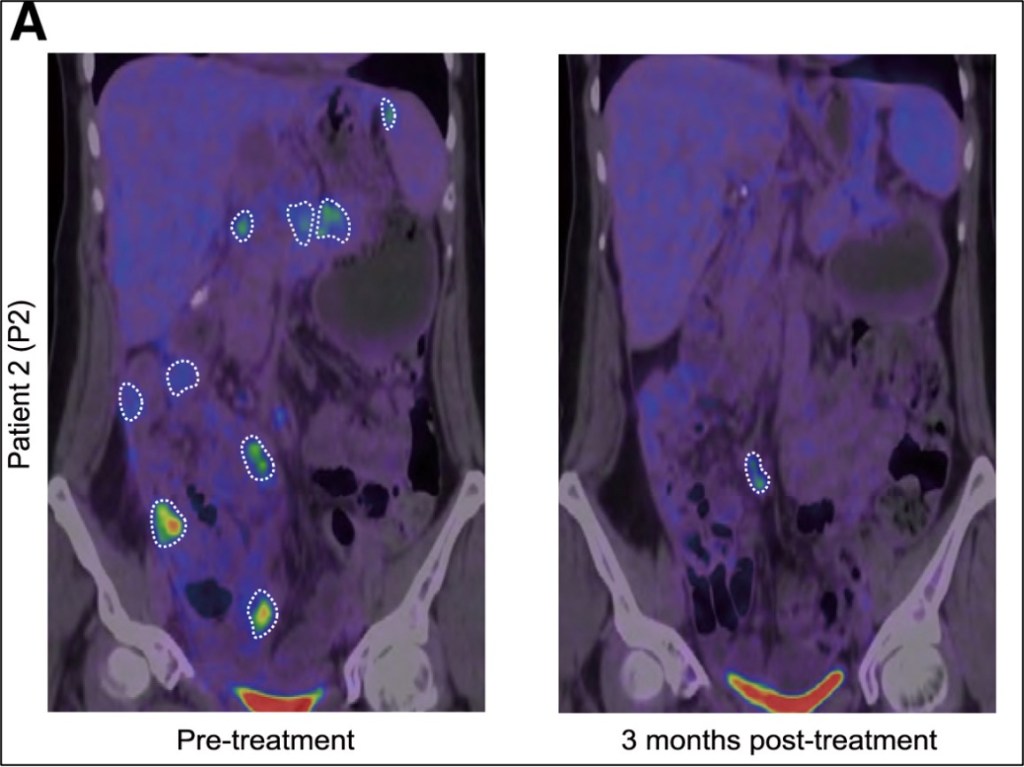
Some pretty amazing results. However, these were in very carefully controlled conditions with monkeys. The researchers took the final step and performed a small clinical with 23 human patients, all suffering from treatment-refractory, metastatic cancers: Hepatocellular, ovarian, lung, cervical, esophageal, rectal, breast, and melanoma. These patients also received infusions of the oncolytic alpha-gal virus. When they biopsied the tumors of a patient suffering from cervical cancer (shown below), they found, post-treatment, that they bore signs of hyperacute rejection usually seen in transplants: Vascular thrombosis, lymphocyte invasion and complement deposition. Overall, of the 23 patients, 1 patient had a complete remission, 6 had partial remissions, and 11 had stable disease, for a total disease control rate of 90%.
This is just one small trial with various types of tumors. But given that remarkable disease control rate, alpha-gal may become a player in the future of cancer immunotherapy, rather than just the reason some people can never enjoy a hamburger again.
Take Home Point
- Alpha-gal transfection by an oncolytic virus may hold promise as a future cancer immunotherapy, by inducing hyperacute rejection of the tumor
Listen to the episode!
https://directory.libsyn.com/episode/index/show/curiousclinicians/id/36284175
CME/MOC
Click here to obtain AMA PRA Category 1 Credits™ (0.5 hours), Non-Physician Attendance (0.5 hours), or ABIM MOC Part 2 (0.5 hours).
As of January 1, 2024, VCU Health Continuing Education will charge a CME credit claim fee of $10.00 for new episodes. This credit claim fee will help to cover the costs of operational services, electronic reporting (if applicable), and real-time customer service support. Episodes prior to January 1, 2024, will remain free. Due to system constraints, VCU Health Continuing Education cannot offer subscription services at this time but hopes to do so in the future.
Credits & Suggested Citation
◾️Episode written by Avi Cooper
◾️Show notes written by Avi Cooper and Giancarlo Buonomo
◾️Audio edited by Clair Morgan of nodderly.com
Cooper AZ, Abrams HR, Breu AC, Buonomo G. Alpha Gal Again. The Curious Clinicians Podcast. April 23rd, 2025.
Image Credit: Shutterstock
 The Curious Clinicians