

Why do SGLT2 inhibitors cause erythrocytosis?
You can watch this episode on our new YouTube channel here!
Most of the time, when we worry about a patient’s hemoglobin, it’s because it’s too low. However, there are times when it’s unexpectedly high, a clinical scenario known as erythrocytosis or polycythemia. There are several well-known causes of erythrocytosis, including chronic obstructive pulmonary disease and polycythemia vera. In this episode, we discuss a more obscure, though nevertheless important, cause: SGLT2 inhibitors.
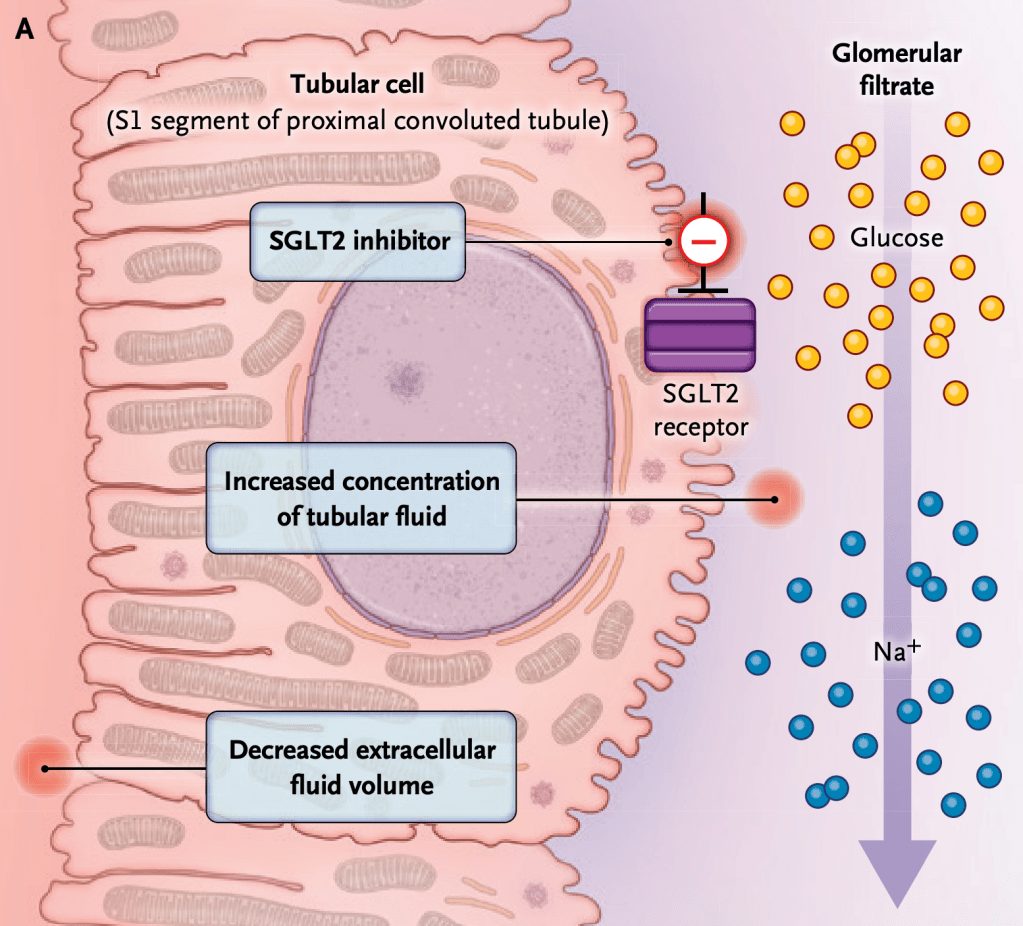
SGLT2 inhibitors are one of the wonder drugs of the 21st century. Their name betrays their function – they inhibit the sodium/glucose cotransporter 2 in the proximal tubule. This leads to the loss of both solutes in the urine. SGLT2 inhibitors like empagliflozin were originally developed as diabetes medications. They were then discovered to not only be extremely effective glycemic control agents but also to have renal and cardio-protective properties.
Although erythrocytosis is not a widely known side effect of SGLT2 inhibitors, it was identified in the first randomized control trial (RCT) of dapagliflozin, published in 2010. Compared to the placebo group, the SGLT2 group had an average increase in hematocrit between 1.0 and 1.7%, which was dose-dependent. A subsequent 2021 meta-analysis of 78 studies showed an average increase of 2.3% in hematocrit and 0.6 g/dL in hemoglobin. Although the average increase is quite small, there have been cases where hemoglobin has risen more than 4 g/dL.
SGLT2 inhibitors have a diuretic-like effect on patients, as the increased solute excretion also leads to the loss of more water. One would wonder, then, if the increase in hemoglobin is just the result of hemoconcentration, just as one sometimes sees in volume-depleted patients. In fact, this was what the authors of the original RCT hypothesized. However, other potent diuretics like furosemide don’t tend to cause persistent rises in hemoglobin and hematocrit. Additionally, if SGLT2 inhibitors were causing chronic volume depletion, one would expect renal function to gradually decline, rather than improve, with extended therapy.
So what is the cause? It like has to do with increased levels of erythropoietin (EPO), the hormone produced by the kidneys that stimulates red blood cell production. Early studies of SGLT2 inhibitors noted increases in both red blood cell mass and EPO, and subsequent meta-analyses have shown an average EPO increase of about 2.6 IU/L. However, patients with chronic kidney disease are still able to increase their EPO after SGLT2 inhibitor therapy. Given that such patients often have low EPO due to malfunctioning kidneys, that EPO increase could be coming from elsewhere.

In utero, the liver is the main source of EPO production. After birth, it switches to the kidneys, and for most people remains there. However, patients with end-stage renal disease (ESRD) are sometimes able to shift EPO production back to the liver. In fact, one study of ESRD patients showed that 53% of them had hepatic EPO production, and some even had normal EPO levels.
Milton Packer, the famed cardiologist, has suggested that SGLT2 inhibitors activate signaling pathways to induce transcription of the EPO gene in the liver. How precisely they do this is unclear. One possibility is that the increased loss of glucose in urine tricks the liver into thinking that energy stores are low. This sets off a series of biochemical “master switches” that aim to preserve existing cells and halt excessive growth. One of these master switch proteins is called sirtuin-1, or SIRT1. Through a chain of mediators, it augments HIF-2α and HNF4, which, in turn, promotes erythropoietin gene transcription.
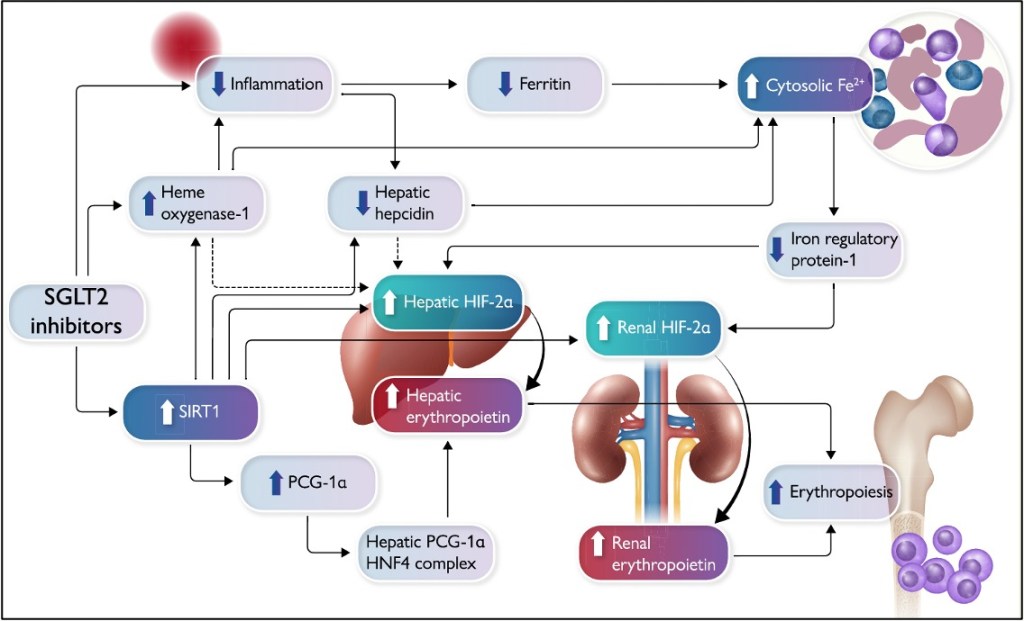
EPO may not be the only mediator through which SGLT2 inhibitors aid not only blood counts but overall health. As anti-inflammatory agents, they decrease hepcidin and ferritin, which are acute phase reactants in addition to iron regulators. However, this decrease in ferritin, which one usually thinks of as a sign of iron depletion, may actually increase cytosolic iron, which is what is used in hemoglobin synthesis. This means it isn’t yet clear whether the decrease in ferritin should prompt iron supplementation after starting an SGLT2 inhibitor. More to come on that front!
Take Home Points
- SGLT2 inhibitors have been shown to cause an increase in hemoglobin.
- This is likely due to augmentation of EPO production, possibly in the liver.
- SGLT2 inhibitors also lead to reductions in hepcidin and ferritin.
Listen to the episode!

123 – Why-roid – The Curious Clinicians
Watch the episode on YouTube!
CME/MOC
Click here to obtain AMA PRA Category 1 Credits™ (0.5 hours), Non-Physician Attendance (0.5 hours), or ABIM MOC Part 2 (0.5 hours).
As of January 1, 2024, VCU Health Continuing Education will charge a CME credit claim fee of $10.00 for new episodes. This credit claim fee will help to cover the costs of operational services, electronic reporting (if applicable), and real-time customer service support. Episodes prior to January 1, 2024, will remain free. Due to system constraints, VCU Health Continuing Education cannot offer subscription services at this time but hopes to do so in the future.
Sponsor
This episode is sponsored by Cozy Earth. Use code CURIOUS for 35% off at cozyearth.com, and embark on your travels in comfort!
Credits & Suggested Citation
◾️Episode written by Tony Breu
◾️Show notes written by Giancarlo Buonomo and Tony Breu
◾️Audio edited by Clair Morgan of nodderly.com
Breu AC, Abrams HR, Cooper AZ, Buonomo G. Less Sugar, More Blood. The Curious Clinicians Podcast. May 29th, 2024.
Image Credit: Health Jade
 The Curious Clinicians